
Market Review: Energy Wheeling in South Africa
Energy wheeling in South Africa provides businesses with a cost-effective and sustainable energy solution. By facilitating partnerships between customers and Independent Power Producers (IPPs), we enable the seamless allocation of renewable energy through the national grid.
Our tailored approach ensures a commercially beneficial structure, accelerates and de-risks project timelines, and provides transparent electricity bill reconciliation, delivering significant cost savings compared to traditional energy sources.
What is Wheeled Energy in South Africa?
Wheeled energy is the process of transmitting electricity generated from renewable energy sources, such as solar or wind, through an existing electricity grid to the end-user.
Independent Power Producers (IPPs) generate the energy and use the national grid infrastructure to “wheel” it across distances to businesses or consumers who want to purchase green energy.
This enables customers to access renewable power without the need to invest in their own generation infrastructure, making it a cost-effective, scalable, and sustainable energy solution.
How Does Energy Wheeling Work?
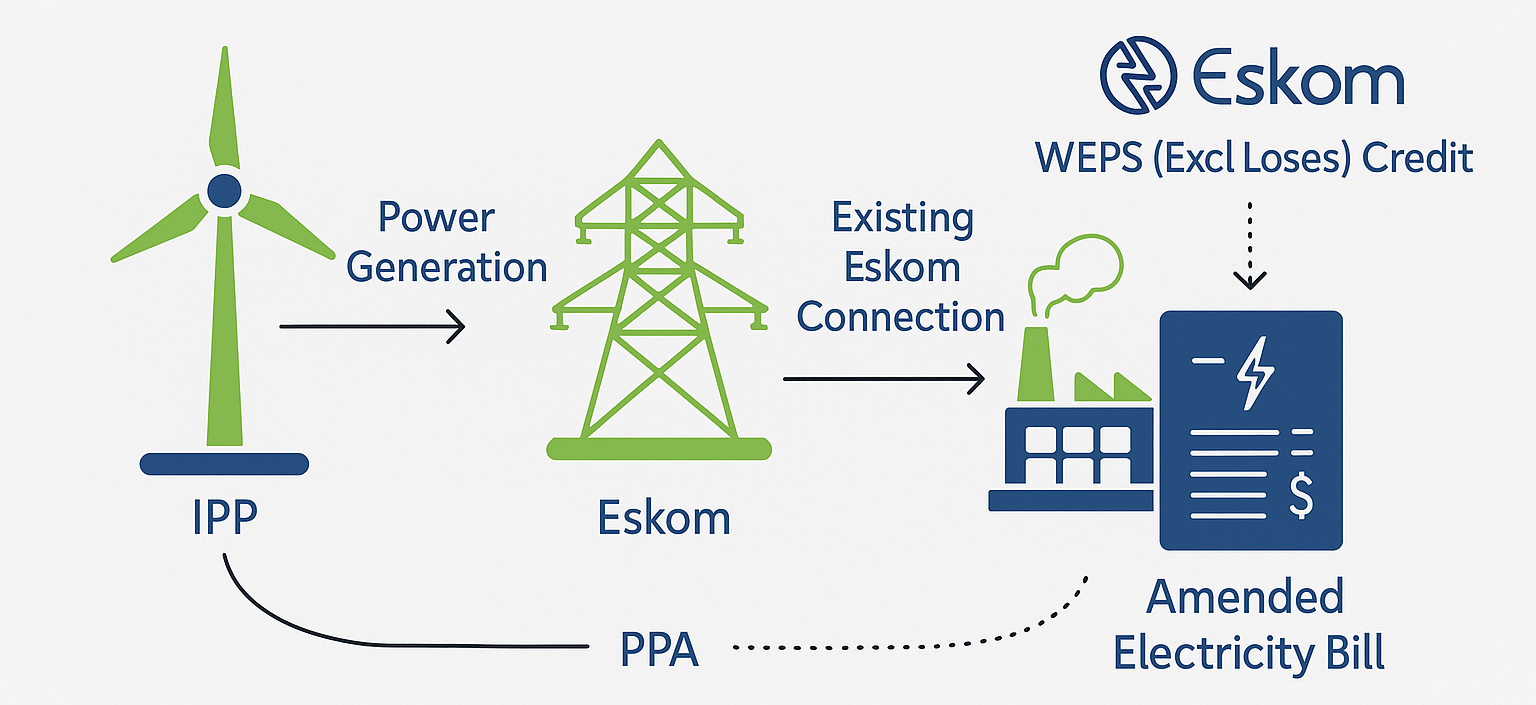
Wheeling in South Africa allows privately generated electricity—typically from renewable sources like wind or solar—to be delivered to an end-user (the offtaker) through Eskom’s transmission network. An Independent Power Producer (IPP) generates electricity at one location and feeds it into the Eskom grid. This power is then “wheeled” to the offtaker, who receives it via their existing Eskom connection at a different location.
A Power Purchase Agreement (PPA) governs the commercial terms between the IPP and the offtaker. Eskom facilitates this transaction by tracking the energy flow, applying a credit to the offtaker’s electricity bill (excluding network losses) through the Wheeling Energy Purchase System (WEPS), and charging a wheeling fee. This mechanism enables businesses to procure renewable energy remotely while still using Eskom’s infrastructure. The illustration below gives a simplified overview of how this process works.
Why Wheel Energy Now?
Investment Required
The National Grid requires over R200 billion to develop 14,000 km of new transmission infrastructure.
REIPPP Growth Incoming
Bid Windows 7 and 8 are expected to each deliver 5 GW of new generation capacity.
Private Pipeline Expands
More than 20 GW of energy projects are estimated in the private offtaker pipeline.
Grid Pressure Mounting
Capacity constraints and rising electricity prices are expected from Q4 2025 onwards.
Funding Delayed
Eskom's transmission upgrade funding only becomes substantial after 2030.
Grid Capacity Map — South Africa
Explore the potential for connecting new generation projects in South Africa. This map, based on the GCCA, provides an overview of the available grid capacity across the country. Click on the map marker for more information about the region.
Frequently Asked Questions
About Wheeled Energy
Does wheeling help me during load-shedding?
What does Eskom charge for wheeling?
What are the costs of wheeled energy?
Does wheeled energy work if I already have an embedded solar site?
How do I report on the green attributes received from wheeled energy?
Power Purchase Agreements include the environmental benefit associated with renewable energy by way of Renewable Energy Certificates (RECS). These will be issued to the customer throughout the duration of the power purchase agreement and will enable the customer to make reliable claims with regards to their ESG Goals.
Whether you’re looking for more information on how wheeling works or need guidance on how it can benefit your business, our team is ready to provide the support you need at info@solinkbrokers.co.za.